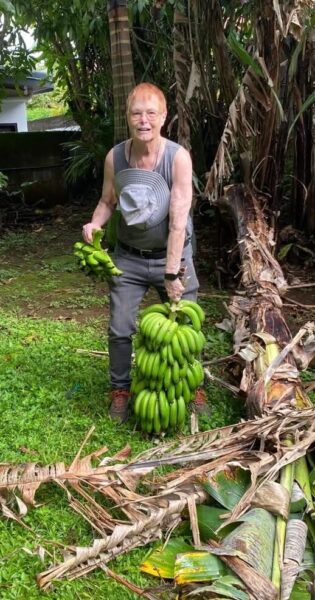
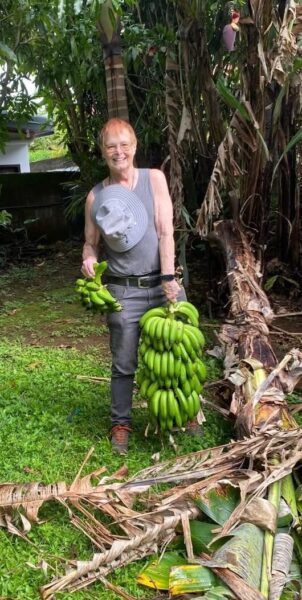
Today I harvested bananas from a tall tree for the first time in my life. That certainly wasn’t on my bucket list but by golly, it was fun!
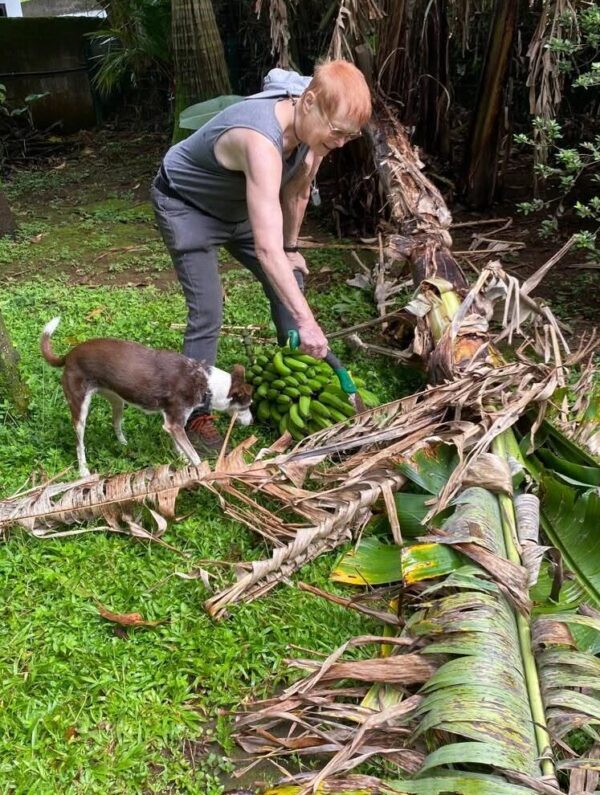
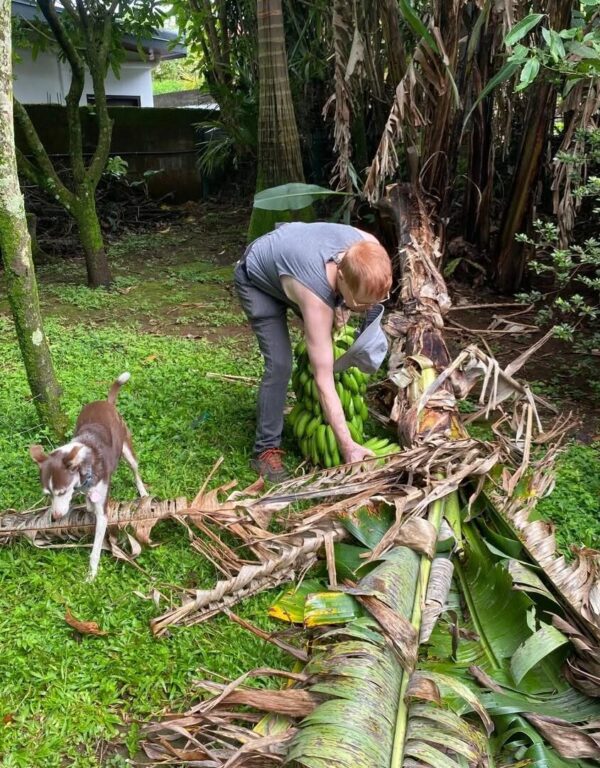
As you can see,
I remembered to ask Cindy to document the occasion!
The tree was in her back yard. The bananas were hanging in two bunches about 15 feet over our heads. The tree was leaning, creaking and cracked near the base; we knew it would come down in a windstorm soon.
Cindy worried that it would fall wrong and get hung up on other trees on the way down. I told her that by working together, we could probably direct it to fall where she wanted it to go.
She brought out a handsaw. I took a notch out of one side of the “trunk”, then sawed the other side while we both shoved it in the direction we wanted it to fall.
Just before it came down, I said, “Call the dogs and stand far enough away with them so that if it doesn’t come down right, everyone will be out of harm’s way.”
After she did that, I gave it a final heave ho and it came down exactly where we wanted it to.
Exito! Qapla! Success!
That’s when I remembered, “Oh, we gotta get photos!”
So, Cindy did the honors. (She doesn’t like being in pictures, or I’d have asked for a selfie of both of us.)
The big bunch of bananas probably weighed 35+ pounds.
The smaller bunch fit into my hat. Cindy carried those to her place while I lugged the big bunch down to where she wanted it parked to finish ripening. Then she put the smaller bunch in a bag for me to take home. I’ll be getting more later as they ripen.
Banana Harvest Time is Months Long
…around here and is very cool. Everyone who has banana trees in their yards cuts them down when they’re ready to be harvested.
And because the bunches ripen at about the same time, homeowners often put small family-size bunches out on the street so neighbors who don’t have banana trees can carry them home to bake with and enjoy as snacks.
The same thing happens with people
…who have mangos, avocados, and other fruit trees in their yards. In this way the “extras” go to families that don’t have fruit trees; they just pick them up (free!) and carry them home!
Costa Rica is a country whose culture takes “helping the least of these” (the poor, struggling, infirm, unhoused, etc.) very seriously. That’s also why the native fruits around here aren’t sold at exorbitant prices: they can’t be; nearly everyone knows someone who gives their extra fruits away during the growing season — and the growing season is pretty much year ’round here! There’s always something getting ripe and abundant most months of the year.
And the taste right off the trees?
You’ll never taste anything superior, buying it from a store. Sun-kissed, rain-soaked fruit is the nectar of the gods.
NOTE TO ECO WARRIORS:
We didn’t “kill” the tree by cutting it down!
Banana “trees” aren’t actually trees; they’re large perennial herbs.
- Their “trunk” (technically, the pseudostem) is composed of compactly wrapped leaf layers.
- Each “tree trunk” (technically a stalk) produces fruit just one time and then dies.
- The living root system (called a rhizome or corm) lives on, pushing up new shoots (called “pups” or “suckers”) from the base.
- A new shoot grows into a full-sized plant and bears its own bananas in just six to seven months.
- And cutting down the old, spent stalk is actually required to keep it from rotting and attracting pests while making room for the next generation of bananas.
So, there you have it. I’m suddenly an expert (ha ha) on banana “trees” (with a little help from AI on the above bullet points, but nowhere else)!